
@Environment is a property wrapper that gives views access to shared dependencies—Calendar, Locale, ColorScheme, and others built into SwiftUI.
struct CalendarView: View {
    @Environment(\.calendar) var calendar: Calendar

    var body: some View { }
}
But what about app-specific dependencies? Say you want an ImageFetcher available to any view that displays remote images, with caching across screens.
SwiftUI supports this through custom environment keys:
struct MovieCell: View {
    @Environment(\.imageFetcher) var fetcher: ImageFetcher
    var movie: Movie

    private var poster: AnyPublisher<UIImage, Never> {
        fetcher.image(for: movie.posterURL)
    }

    var body: some View { }
}
Implementation
Two pieces are required: an EnvironmentKey and an extension on EnvironmentValues.
Define the key
EnvironmentKey requires a default value for your dependency:
public protocol EnvironmentKey {
    associatedtype Value
    static var defaultValue: Self.Value { get }
}
struct ImageFetcherKey: EnvironmentKey {
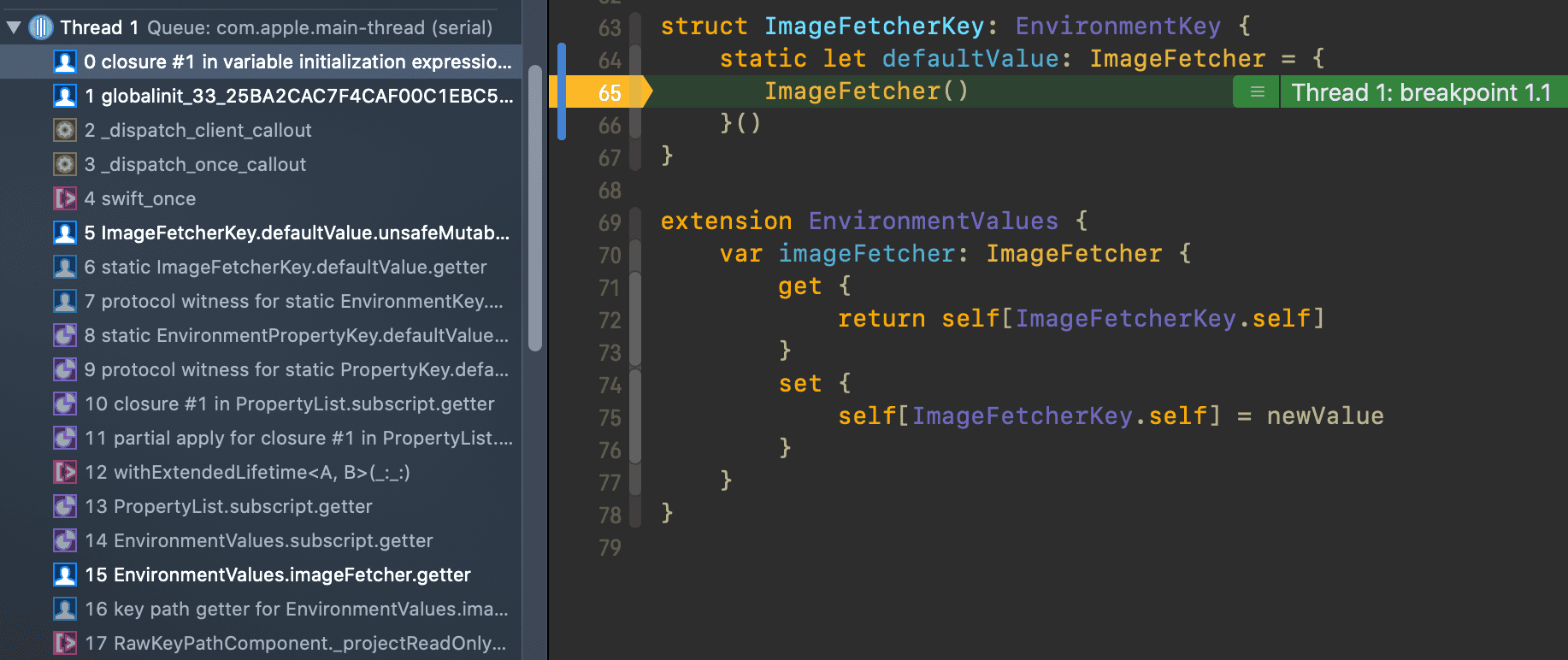
static let defaultValue = ImageFetcher()
}The defaultValue is instantiated lazily on first access via @Environment.
Expose the property
Extend EnvironmentValues to provide the key path used with @Environment:
extension EnvironmentValues {
    var imageFetcher: ImageFetcher {
        get { self[ImageFetcherKey.self] }
        set { self[ImageFetcherKey.self] = newValue }
    }
}
That’s it. Any view can now access @Environment(\.imageFetcher).
Full implementation available here.